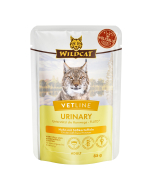
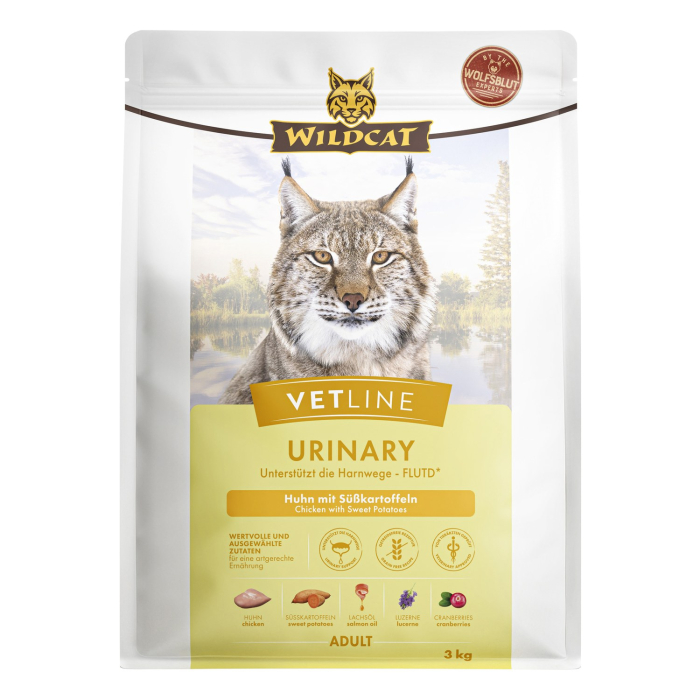
WILDCAT VetLine Urinary Chicken for Cats | Dry Food | PV
Starting at CHF 6.70
Dietetic complete feed from Wolfsblut for adult cats
- For cats with urinary tract problems (FLUTD)
- Can help to dissolve struvite stones
- Reduces the risk of struvite stones recurring
Details
WILDCAT VetLine Urinary Chicken: dry food for cats with urinary tract problems
For cats with lower urinary tract disease (FLUTD): WILDCAT VetLine Urinary can help to dissolve struvite stones and reduces the risk of them coming back. The dry food is available in 400 g to try and in 3 kg for long-term feeding.
Food for struvite stones and FLUTD
Struvite stones form mainly when the urine is too alkaline. A urinary cat food slightly acidifies the urine and has an adjusted magnesium content. Wet food provides additional fluid, which dilutes the urine.
WILDCAT VetLine is Wolfsblut's dietetic range for cats. Please discuss the choice of food and the feeding period with your vet. You can find all varieties and help with choosing on the page WILDCAT VetLine dietetic food for cats.
Urinary – supports the urinary tract (FLUTD*)
WILDCAT VetLine Urinary is a dietetic complete feed for adult cats to support urinary tract health; it can help to dissolve struvite stones and reduce struvite stone recurrence.
Many cats struggle with lower urinary tract complaints again and again during their lives. The term FLUTD (*Feline Lower Urinary Tract Disease) covers all of these distressing conditions. Because cats naturally often drink too little, their urine is frequently highly concentrated. This can cause excess minerals to combine into small crystals or fine grit. If these deposits grow larger, painful urinary stones form. Struvite stones, which consist of a magnesium ammonium phosphate compound, are particularly common. They form mainly when the urine has a pH value that is too high, i.e. alkaline – and can be very unpleasant for affected cats.
With urinary tract disease and struvite stones, the cat shows one or more symptoms, including:
Frequent urge to urinate
Problems urinating
Sudden house-soiling
WILDCAT VetLine Urinary is tailored precisely to your cat's nutritional needs in cases of lower urinary tract disease (FLUTD – Feline lower urinary tract diseases).
Developed in collaboration with vets and nutritional scientists, WILDCAT combines modern nutritional science with a species-appropriate feeding philosophy and carefully selected ingredients.
The recipe of WILDCAT VetLine Urinary can dissolve existing struvite stones and help prevent them from forming again. The adjusted magnesium and phosphorus content helps to prevent struvite stones. The addition of DL-methionine and ammonium chloride ensures targeted acidification of the urine – an important prerequisite for dissolving struvite stones. At the same time, the recipe helps to optimise the urinary pH value and thus reduce the risk of new stone formation.
At a glance:
Dietetic complete feed for adult cats to support urinary tract health; can help to dissolve struvite stones and reduce struvite stone recurrence.
Suitable for cats with FLUTD (*Feline lower urinary tract diseases)
Adjusted magnesium content can reduce the recurrence of struvite stones
The urine-acidifying properties lower the pH value of the urine and are suitable for dissolving struvite stones.
Tasty chicken as the main ingredient
Grain-free recipe
With the prebiotic fibres MOS and FOS
Recipe without added maize, gluten, soya, flavour enhancers and artificial additives (except vitamins & minerals)
Developed with vets
No animal testing
Important note:
Not suitable for kittens, pregnant and nursing cats, cats with chronic kidney insufficiency or heart failure, and not for reducing the formation of oxalate stones.
Please note that dietetic complete feeds can only support veterinary treatment, not replace it. Seek the advice of a vet before use or before extending the feeding period.
Gradual food transition:
A slow transition over about 14 days is recommended. Exception: if your vet recommends otherwise. In the case of acute health problems, it may be necessary to switch completely to the therapeutic food straight away.
Please keep an eye on how your pet is doing – regularly monitor stool consistency and appetite.
Composition
Chicken 41 % (dried 27 %, fresh 14 %), sweet potatoes 30 %, pea protein, chicken fat, alfalfa 4 %, chicken broth, apple pomace, salmon oil 0.5 %, MOS, FOS, Jerusalem artichoke, potassium chloride, psyllium husks, algae, cranberries 0.01 %. Urine acidifiers: DL-methionine, ammonium chloride.
Analytical constituents
Crude protein 34 %, crude fat 18 %, crude fibre 3.5 %, crude ash 7.5 %, calcium 1 %, phosphorus 0.9 %, sodium 0.4 %, magnesium 0.1 %, potassium 0.8 %, chloride 0.9 %, sulphur 0.5 %, urinary pH 6.3. · ME 393 kcal / 100 g
Feeding guide
| Cat's weight in kg | Daily amount of food in grams |
| 2 | 30 |
| 3 | 40 |
| 4 | 50 |
| 5 | 60 |
| 6 | 70 |
| 7 | 75 |
Recommended feeding period: the food should be fed for 5 to 12 weeks to dissolve struvite stones, and for up to 6 months to reduce the recurrence of struvite stones.
Important note: dietetic complete feeds support veterinary treatment but do not replace it. Consulting a vet is recommended before use and before extending the feeding period.
The amounts given are a guideline and should be adjusted to your cat's individual needs. Every cat is unique – the optimal amount to feed depends on many factors such as age, sex, activity, metabolism and environment.
Always provide fresh, clean drinking water.
Gradual food transition:
A slow transition over about 14 days is recommended.
Exception: if your vet recommends otherwise. In the case of acute health problems, it may be necessary to switch completely to the therapeutic food straight away.
Please keep an eye on how your pet is doing – regularly monitor stool consistency and appetite."