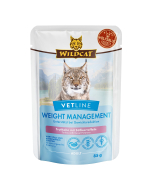
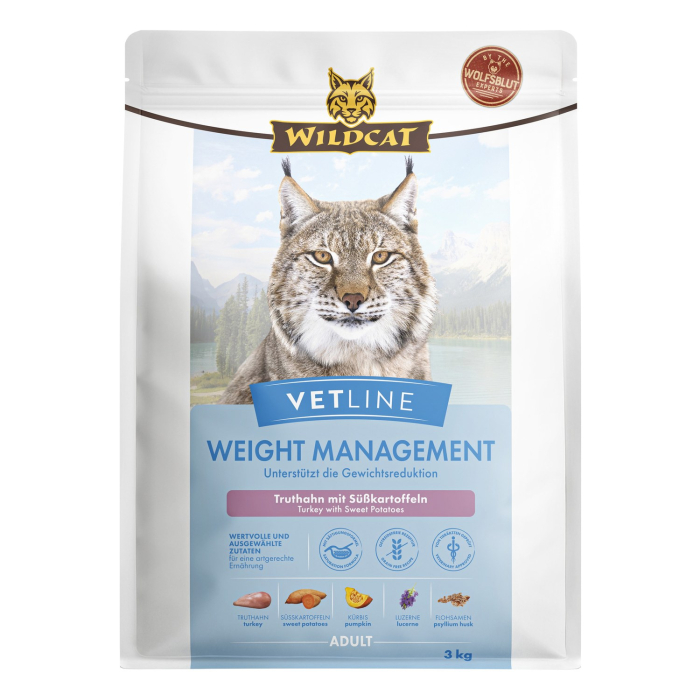
WILDCAT VetLine Weight Management Turkey for Cats | Dry Food | PV
Starting at CHF 6.70
Dietetic complete feed from Wolfsblut for adult cats
- For overweight and diabetes mellitus
- Low in energy and fat, rich in protein
- Fibre for long-lasting satiety
Details
WILDCAT VetLine Weight Management Turkey: dry food for overweight cats
For overweight cats and cats with diabetes mellitus: WILDCAT VetLine Weight Management is low in energy and fat and provides plenty of protein, so that muscle is preserved during weight loss. The dry food is available in 400 g to try and in 3 kg for long-term feeding.
WILDCAT VetLine is Wolfsblut's dietetic range for cats. Please discuss the choice of food and the feeding period with your vet. You can find all varieties and help with choosing on the page WILDCAT VetLine dietetic food for cats.
Weight Management – supports weight reduction
WILDCAT VetLine Weight Management is a dietetic complete feed for adult cats for the reduction of excess weight and the regulation of glucose supply in diabetes mellitus.
Excess weight in cats often develops slowly and goes unnoticed at first. The first signs may appear when you can no longer feel your cat's ribs easily when stroking it, or when its waist is no longer clearly visible. Excess weight can affect your cat's health in the long term. Possible consequences include strain on the cardiovascular system, increased stress on the joints and a higher risk of diabetes mellitus. An early assessment of body condition helps to prevent such conditions. If weight loss becomes necessary, it should always be controlled and gentle. It is important that the cat continues to receive all essential nutrients and that muscle is preserved. A high-quality, well-balanced weight-reduction diet can help to reduce weight in a healthy way without putting strain on the body. With overweight and/or diabetes mellitus, the cat shows one or more symptoms, including:
Increased body weight and a tendency to gain weight
Reduced activity and tiring quickly
Increased appetite
WILDCAT VetLine Weight Management is tailored precisely to your cat's nutritional needs in cases of overweight and diabetes mellitus. Developed in collaboration with vets and nutrition scientists, WILDCAT combines modern nutritional science with a species-appropriate feeding philosophy and carefully selected ingredients. WILDCAT VetLine Weight Management stands out with a high protein content combined with low fat and energy content. The high-quality proteins help to preserve muscle, while the increased fibre content provides a long-lasting feeling of fullness. Glucosamine and chondroitin contribute to a normal joint metabolism and thus help to maintain joint function. The food is also tailored to the needs of diabetic cats, as carbohydrates that cause rapid glucose release have been kept as low as possible. This regulates the glucose supply in a natural way.
At a glance:
Dietetic complete feed for adult cats for the reduction of excess weight and the regulation of glucose supply in diabetes mellitus
Low energy and fat content contribute to weight reduction
Optimised amount of fibre for long-lasting satiety
High-quality proteins to help preserve muscle
With glucosamine and chondroitin to support joint metabolism
Low monosaccharide and disaccharide content
Tasty turkey as the main ingredient
With the prebiotic fibres MOS and FOS
Grain-free recipe
Recipe without added maize, gluten, soya, flavour enhancers or artificial additives (except vitamins & minerals)
Developed with vets
No animal testing
Important note:
Not suitable for kittens, pregnant or nursing cats.
Please note that dietetic complete feeds can only support veterinary treatment, not replace it. Seek the advice of a vet before use or before extending the feeding period.
Gradual change of food:
A slow change of food over about 14 days is recommended.
Exception: if your vet recommends otherwise. In the case of acute health problems, it may be necessary to switch completely to the therapeutic food immediately.
Please keep an eye on how your pet is doing – that is, regularly monitor stool consistency and appetite.
Composition
Turkey 31 % (dried turkey 16 %, fresh turkey 15 %), pea protein, sweet potatoes 15 %, peas, apple pomace, alfalfa 6 %, pumpkin 2 %, chicken broth, chicken fat, salmon oil, potassium chloride, MOS, FOS, Jerusalem artichoke, sodium chloride, psyllium husks 0.1 %, algae, methylsulfonylmethane (MSM), cranberries, chondroitin sulphate 0.01 %, glucosamine 0.01 %. Carbohydrate sources: sweet potatoes, peas, pumpkin.
Analytical constituents
Crude protein 35 %, crude fat 8 %, crude fibre 8 %, crude ash 8.5 %, calcium 1.5 %, phosphorus 1.1 %, linoleic acid 1 %, omega-3 fatty acids 0.15 %, omega-6 fatty acids 1.03 %, DHA* / EPA** 0.04 %, starch 18 %, sugar 3.6 %. ME 326 kcal / 100 g
Feeding guide
| Cat's weight in kg | Daily amount of food in grams | |
| Amount for weight maintenance | Amount for weight reduction | |
| 2 | 30 - 35 | 25 |
| 3 | 40 - 50 | 35 |
| 4 | 50 - 60 | 40 |
| 5 | 55 - 70 | 45 |
| 6 | 65 - 75 | 50 |
| 7 | 70 - 85 | 60 |
Recommended feeding period: A transition phase at the start of the diet is recommended. For efficient weight loss or to maintain the ideal weight, the recommended daily energy intake should not be exceeded. Recommended duration: until the target weight is reached, and long term to prevent renewed weight gain. The recommended daily amount of food for weight reduction is based on the cat's current weight, its average calorie requirement and a desired safe weight loss of 1 % of body weight per week. The daily amount of food must be adjusted according to the response, usually every 2 to 4 weeks. The recommended feeding period for glucose regulation is initially up to 6 months.
Important note: Dietetic complete feeds support veterinary treatment but do not replace it. Consulting a vet is recommended before use and before extending the feeding period.
The amounts given serve as a guideline and should be adjusted to your cat's individual needs. Every cat is unique – the optimal amount to feed depends on many factors such as age, sex, activity, metabolism and environment.
Always provide fresh, clean drinking water.
Gradual change of food:
A slow change of food over about 14 days is recommended.
Exception: if your vet recommends otherwise. In the case of acute health problems, it may be necessary to switch completely to the therapeutic food immediately.
Please keep an eye on how your pet is doing – that is, regularly monitor stool consistency and appetite."