
Whether it's a nano cube, a one-metre aquarium or a five-metre tank: every aquarium has its pros and cons. This guide helps you with the first decisions: which questions should you ask yourself before buying, which type of aquarium suits you, where can it go, how heavy will it be and which size suits which stocking?
Which questions should you ask yourself before getting an aquarium?
Keeping an aquarium is a wonderful and very calming hobby that delights young and old. You've probably eyed up an aquarium at some point and then not quite dared to take the plunge. At first glance it looks very simple: set up the tank, fill it with water, add a few plants and some gravel, then put in the beautiful colourful fish. Done! But if you want to enjoy it for a long time, there are a few important things to consider before you buy. This checklist will help you:
- Am I ready to learn about basic water chemistry and the natural processes in my aquarium? You really should pick up some basic knowledge of what actually happens in an aquarium. It makes care easier and you'll know what to do when problems arise. An aquarium is a small ecosystem that needs to be kept in balance.

- Am I ready to commit to my aquarium for several years? Fish are animals too! Before you buy, think about how to keep and feed them in a species-appropriate way. Species-appropriate means that the furnishings and the fish stock are matched so that everyone feels at home. You should also be aware that, with good care, a fish can easily live for several years.
- Who wants the aquarium? We're thinking mainly of children here. Aquariums are fascinating for kids, but you should always consider their age. You can't expect a child to look after an aquarium alone. Enthusiasm is often huge at the start, but children quickly lose interest. As a beginner, you also have to expect to lose fish now and then through care mistakes. Can your child cope with that? If the child is meant to finance the hobby from their pocket money, things could get tight very quickly.
- What does an aquarium actually cost and how much money do I want to invest in the hobby? Keeping an aquarium is a lovely hobby, but also a rather expensive one. The initial costs are relatively high, and running costs, especially electricity, are not negligible either. So before you buy, consider whether you're prepared to keep investing money in the hobby over the long term.

- How big should the aquarium be? Find out how much space you have and which fish you'd like to keep in the aquarium. Not every fish species can be kept in the same tank, because, as with other pets, there are legal minimum dimensions.
- Where do I want to put the aquarium? Above all, consider the load-bearing capacity of the floor and the natural light. It's also worth choosing a well-heated room so the thermostat heater needs less electricity. You'll find more on this further down in the sections on location and weight.
- Do I have the desire and the time to look after my aquarium regularly? A very important point that is often underestimated. Whatever its size, an aquarium needs care, some more, some less. Ask yourself whether you want to put in the time, and how much.

- Who looks after my aquarium when I'm on holiday or ill? An aquarium can manage a week or more without much care. The fish still need to be fed regularly and their health checked. It also makes sense to check the equipment regularly.
It's always worth giving it some thought beforehand. Countless aquariums end up in the cellar after a short time because nothing works as it should and the frustration eventually gets too much. As a newcomer to the hobby in particular, it's important to have a knowledgeable point of contact who gives you good, honest advice. In the age of the internet there's an overload of information, and in aquatics, where there is no fundamental right or wrong, it's easy to get lost.
Which types of aquarium are there?
Community aquarium, nano cube, aquascaper's tank: you've surely heard these terms. Aquarium types differ mainly in water quality, stocking and furnishings. Here's an overview of the individual types.
The community aquarium
The most common aquarium is probably the community aquarium. Here you usually keep several different fish with similar requirements for water parameters and furnishings. This type is very popular with beginners because the tank is so varied. You usually keep a mix of fish, catfish, snails and even shrimp in it.

The species aquarium
Unlike a community tank, a species tank houses only one fish species. The reasons are usually the special needs and behaviour of the chosen species, which rule out living with other species. You'll find species tanks, for example, in nano aquariums housing dwarf shrimp or fighting fish. A species tank is also a must for dwarf clawed frogs, pufferfish or piranhas.
The biotope aquarium
A biotope aquarium can also be a community tank. Here, however, a small section of a natural habitat is recreated. Substrate, plants and stocking are adapted to this biotope. The best known is probably the Amazon tank, in which only fish from the Amazon are kept. Some aquarists even go so far as to choose only plants that occur in that region. A Malawi tank or an Asian aquarium are also biotope aquariums.
The coldwater tank
The coldwater aquarium is one of the most original aquarium types. It is usually a kind of biotope or species aquarium. Unlike the other types, the water here is no warmer than 20 degrees, and usually cooler. Since the fish kept are mostly relatively large, this kind of aquarium should be at least 100 cm long, preferably even larger. In coldwater tanks you keep coldwater fish such as sunbleaks, goldfish or minnows. As the metabolism of animals and plants depends on the ambient temperature, it may be necessary to cool the aquarium down. When choosing plants, also make sure to use special coldwater plants.

The blackwater tank
The amber-coloured water is one of the most obvious features of the blackwater aquarium. It has almost no carbonate hardness, a low pH and very low conductivity. The blackwater aquarium is also a biotope aquarium, as only certain fish feel at home in it because of the altered water values. You achieve the dark colour and the altered water values through dissolved tannins, humic acids and flavonoids from leaf litter, roots or cones, as well as peat. Compared with a "normal" aquarium, a blackwater aquarium has a very acidic pH of just 5 to 6.
The aquascape
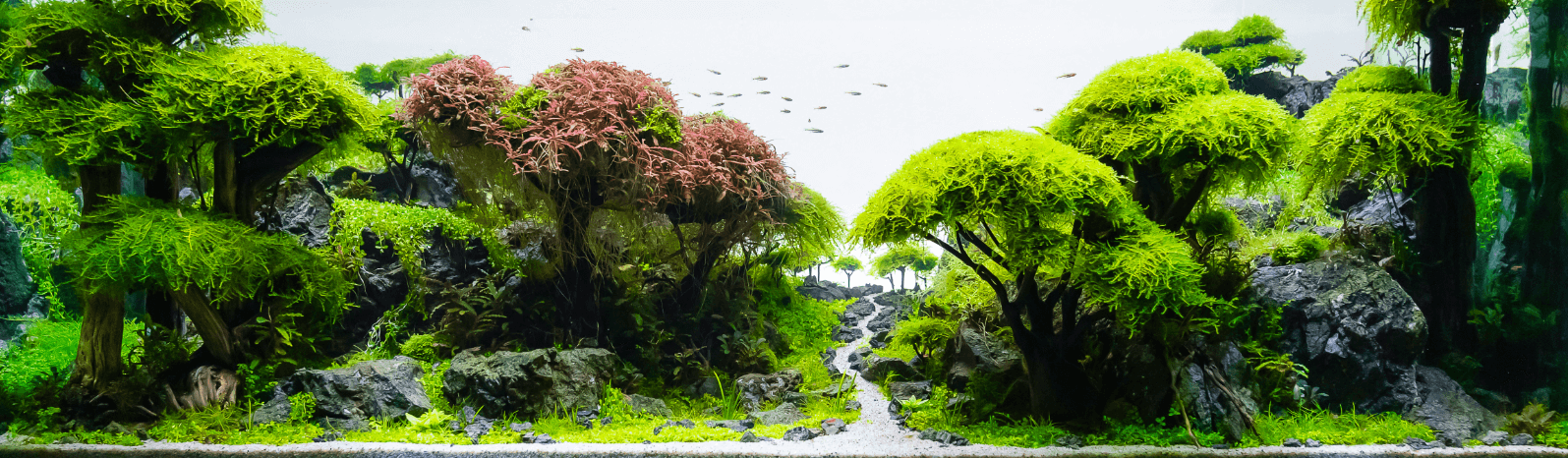
Aquascapes became known worldwide mainly thanks to Takashi Amano. With this type of aquarium, the main focus is on design. An underwater landscape is created with plants and hardscape materials such as wood, stones and rocks. The plants in particular are the focus. The aquarium equipment should not be visible and is usually made of glass. Sometimes shrimp or snails are added, and rarely fish. There are even world championships in aquascaping now, where the seemingly impossible is often made possible.
The Dutch aquarium
The Dutch aquarium primarily resembles an aquascape. However, much more emphasis is placed on the golden ratio when arranging the plants. The NBAT (Nederlandse Bond Aqua Terra) has its own set of rules on how the aquariums may be arranged. The plants are planted like flower beds and clearly separated by height, leaf shape and colour. The back and side panes should no longer be visible. They are often covered with wooden panels that can be overgrown with moss. Stone structures are avoided; only roots liven up the design. Fish are rarely kept in a Dutch aquarium. If they are, the choice of species, in number and appearance, follows the aquarium's design. They are often South American tetras.
The marine aquarium
Marine aquariums are considerably more demanding than freshwater aquariums. They differ in equipment, stocking, choice of plants, furnishings and care. The most common marine aquariums are those that recreate a coral reef. Alongside fish, many invertebrates such as corals, anemones and snails, as well as crabs, lobsters and shrimp, are kept here. You can also recreate specific sections of a habitat, such as deep-sea aquariums or Baltic Sea tanks with the corresponding stocking.

Marine aquariums use significantly more equipment, and they require quite a lot of expertise to keep everything running. Marine aquatics is also more expensive to set up and maintain than freshwater aquatics.
Which aquarium size suits which stocking?
When choosing the right aquarium, the first question to ask yourself is which fish you want to keep in it. Depending on the species, the demands on size and furnishings vary greatly. As a general rule: the bigger the aquarium, the easier the care!
For stocking and furnishings, you should also first settle on a continent. Requirements for temperature and water parameters differ quite a lot from continent to continent. Here are some examples of aquariums and stocking options:
The nano cube (10 to 30 litres)
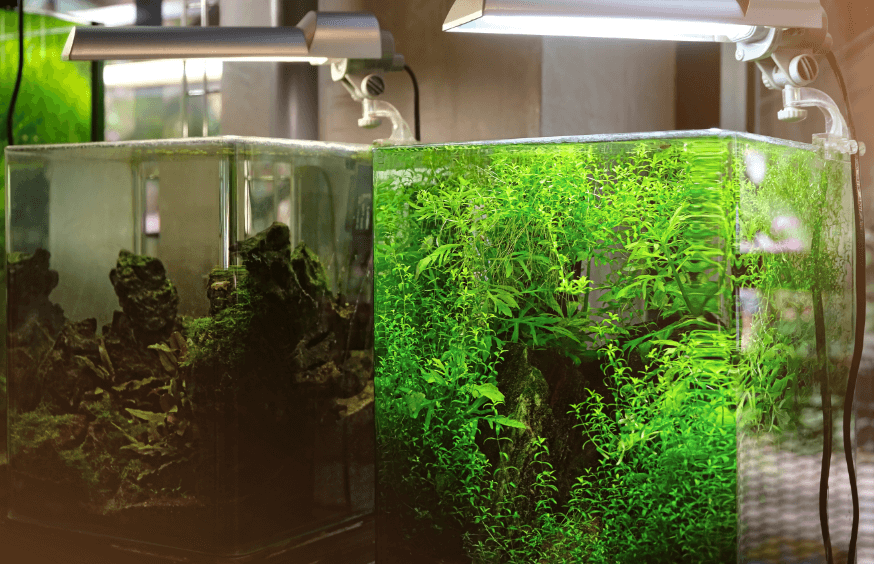
Mini aquariums holding 10 to 30 litres of water are called nano cubes. As the name suggests, the cubes are mostly cube-shaped. They come, for example, in these sizes (width / depth / height):
- 10 litres: 20 x 20 x 25 cm
- 20 litres: 25 x 25 x 30 cm
- 30 litres: 30 x 30 x 35 cm
These nano aquariums all fall short of the minimum edge length of 60 cm required for keeping fish. That means no fish may be kept in them. The one big exception is the Siamese fighting fish. Otherwise, nanos are suitable for keeping shrimp and snails or for raising young fish.
Advantages of a nano cube:
- doesn't take up much space
- relatively inexpensive to buy
Disadvantages of a nano cube:
- very limited fish stocking
- very high-maintenance
- doesn't forgive serious mistakes
- quite a delicate ecosystem
The 60-litre beginner aquarium (60 x 30 x 30 cm)
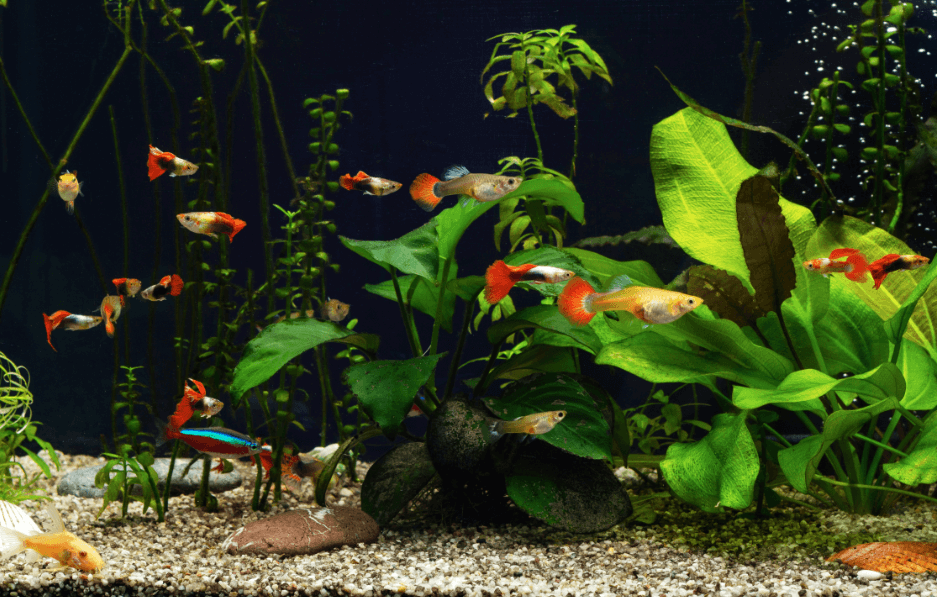
This size is very popular with aquarium newcomers. The aquarium is relatively inexpensive to buy and doesn't take up much space. The edge length here is 60 cm, which is long enough for a small number of fish. In it you can keep, for example, small South American tetras or dwarf cichlids.
The aquarium is also suitable for popular livebearers such as platies and guppies. But beware: these two species breed incredibly fast, and the aquarium quickly becomes overcrowded.
Advantages of a 60-litre aquarium:
- big enough to keep fish in
- relatively inexpensive to buy
- reasonably stable ecosystem
- forgives minor care mistakes
- doesn't take up much space
Disadvantages of a 60-litre aquarium:
- very limited fish stocking
- quite high-maintenance
The 125-litre aquarium (83 x 36 x 50 cm)
With an edge length of 80 cm, the 125-litre aquarium is only slightly bigger than the 60-litre tank. Even so, you already have many more options here.
You can keep South American tetras and dwarf cichlids here, for example. The aquarium is also suitable for livebearers such as platies and guppies, including the slightly larger mollies. Smaller species of Asian barbs and danios, as well as gouramis and honey gouramis, will also feel at home here. You can also keep some shrimp species, such as the Amano shrimp. This size is also suitable for dwarf clawed frogs.

Advantages of a 125-litre aquarium:
- big enough to keep somewhat larger fish too
- stable ecosystem
- forgives even fairly big care mistakes
- doesn't take up much space
- more options for fish stocking
Disadvantages of a 125-litre aquarium:
- somewhat more expensive to buy and run
- relatively heavy
The 180-litre aquarium (101 x 41 x 50 cm)
With an edge length of 100 cm, the 180-litre aquarium is already a considerable size. The options for fish stocking are much wider here than at 80 cm. From South American tetras and livebearers to Asian barbs and danios, there are many beautiful stocking options. Slightly larger gouramis and even some cichlid species such as the keyhole cichlid feel at home here too. You can also keep armoured catfish and smaller L-number catfish in it.

Advantages of a 180-litre aquarium:
- big enough to keep somewhat larger fish too
- stable ecosystem
- forgives even bigger care mistakes
- more options for fish stocking
- not very high-maintenance
Disadvantages of a 180-litre aquarium:
- expensive to buy and run
- needs a lot of space and is heavy
The 240-litre aquarium (121 x 41 x 55 cm)
The 240-litre aquarium is a great size if you want to build a stable, easy-care and lively aquarium. The edge length of 120 cm meets the needs of a wide variety of fish species and offers plenty of room for attractive aquascaping.
Besides the usual fish such as tetras and barbs, you can also keep larger-growing species here, such as large cichlids or catfish, as well as larger shrimp species such as the bamboo shrimp or the giant fan shrimp. Armoured catfish, bristlenose plecos and other small catfish also feel at home here.

Advantages of a 240-litre aquarium:
- big enough to keep larger fish too
- stable ecosystem
- forgives bigger care mistakes
- many options for fish stocking
- not very high-maintenance
Disadvantages of a 240-litre aquarium:
- expensive to buy and run
- heavy
- needs a lot of space
The 350-litre aquarium (121 x 66 x 51 cm)
The biggest difference from the 240-litre aquarium is the depth of the tank. This creates excellent conditions for an underwater design with a sense of depth. Fish stocking doesn't change much compared with the 240-litre tank, as the stocking calculator is based on edge length. The only addition is that you could already keep a pair of small angelfish here.
Advantages of a 350-litre aquarium:
- big enough to keep larger fish too
- stable ecosystem
- forgives bigger care mistakes
- many options for fish stocking
- not very high-maintenance
- many design options thanks to the greater depth
Disadvantages of a 350-litre aquarium:
- expensive to buy and run
- heavy
- needs a lot of space
On the whole, the bigger the tank, the more the advantages outweigh the disadvantages. In the end, you have to decide which aquarium suits you best.
Where should the aquarium go?
It's worth giving some thought to the location in advance. In the kitchen, the children's room, the bathroom or the cellar: in principle, you can set up an aquarium anywhere. What makes sense, and what you should look out for, is shown in these points:
- The floor must be able to bear the load. Depending on its size, an aquarium weighs a considerable amount. So make sure that the spot where you want to put it has a floor that can carry the weight.

- The floor shouldn't sway or vibrate. It also shouldn't be exposed to constant vibrations.
- Don't place it in a thoroughfare of your home. It's not advisable to put the aquarium in a busy part of the home. Constant foot traffic can stress the animals, causing them to hide or become ill.
- Not next to a television. Don't put the aquarium in a room where the TV or radio is on all the time. A quiet room reduces stress and keeps the fish healthy.
- No direct sunlight. Direct sunlight on the aquarium glass encourages algae growth. The best place for the aquarium is a dark spot in your home with little light from outside. That way you can control the duration and intensity of the light yourself and prevent algae.

- The right room temperature. To save energy, it's advisable to put the aquarium in a relatively warm room. That way the thermostat heater, which warms the water to around 25 degrees, doesn't have to run constantly. In summer, the room also shouldn't get too hot, because in the long term most fish tolerate temperatures above 28 degrees poorly.
- The distance to the nearest water supply. Anyone who has done a large water change knows the problem: the further away the sink or water connection is, the more tedious and time-consuming the job becomes. Think about it when choosing the location: am I prepared to keep going up and down the stairs for the water change if the aquarium is on the upper floor? Or would I rather put it somewhere else?
- Observe animal welfare regulations. A very important point when choosing the location is the legal basis. If the aquarium stands freely in the room, for example, it is absolutely essential to either cover at least two of the four sides with film or screen them off with plants so they are opaque. Alternatively, you can design the middle area of the aquarium so that the fish can hide there out of sight. The fish must also be given a day-night rhythm.

As you can see, a little thought beforehand can make things a lot easier.
How heavy will your aquarium be?
Structural load and total weight are two important points when buying an aquarium. Before buying, people often think about the size or the fish stocking. But the total weight of the fully set-up tank is just as important, and it's often underestimated. To find out how heavy your aquarium will end up, you'll have to do a bit of maths.

Depending on its size, every aquarium has a certain volume. This first tells you how much water fits in, because water has a considerable weight too. Then there's the substrate and the furnishings.
Example: volume and weight of a 100 cm aquarium
The aquarium is 100 cm long, 40 cm deep and 50 cm high. To work out the volume, multiply the tank's length x width x height and divide the result by 1000. This gives you a gross volume of 200 litres.
However, nobody fills their aquarium with water right up to the top edge. There is also a loss of volume due to the thickness of the glass, the substrate and the decoration. The following graphic shows a simplified calculation example for the net volume and total weight of an aquarium of this size:
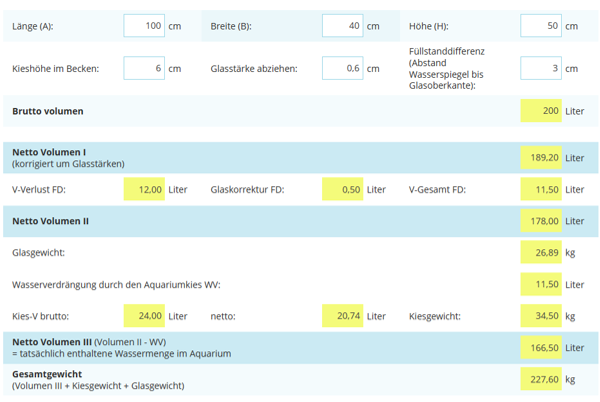
Depending on the amount and type of furnishings, quite a bit more weight can be added, although the water volume decreases again as a result.
The aquarium cabinet also weighs around 30 kg at this size. The weight also depends heavily on how much substrate you choose and which kind, because: the finer the substrate, the more you need to reach the desired depth.
How much does the substrate weigh?
As with the water volume, you calculate length x depth x height ÷ 1000. But don't use the height of the whole aquarium, only the desired substrate depth. On average, people choose around 5 to 6 cm.
However, we don't want to know the volume of the substrate, but its amount in kilograms. For that you need a value that takes into account the density of the material. Here are two examples with a substrate depth of 5 cm: one with gravel of medium grain size, around 3 to 6 mm, and one with sand.
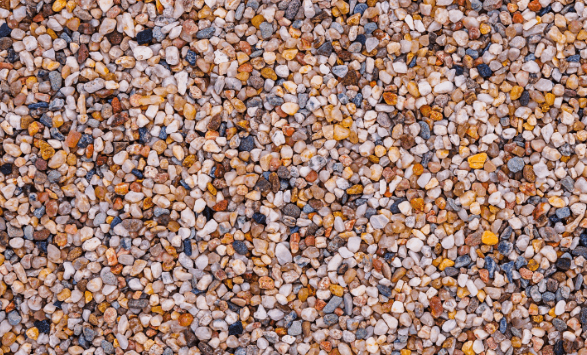
Gravel:
100 cm x 40 cm x 5 cm ÷ 1000 = gravel volume of 20 litres
20 litres x 1.3 = 26 kg gravel

Sand:
100 cm x 40 cm x 5 cm ÷ 1000 = sand volume of 20 litres
20 litres x 1.5 = 30 kg sand
Because of its higher density, the aquarium with sand ends up almost 4 kg heavier than the gravel aquarium.
The example aquarium ends up weighing around 230 kg with gravel and without plants and decoration. Add the cabinet at almost 30 kg. That quickly takes you to a weight of nearly 260 to 300 kg.
Conclusion: plan your aquarium from the start
If you think in advance about where you want to take your tank, you'll enjoy this wonderful hobby for a long time. After all, an aquarium isn't finished from day 1. It takes time and patience until the result is what you imagined. But the waiting, and watching how the tank changes, is also a wonderful part of the process that is fun and worthwhile.
Images: Shutterstock / own illustration