
In the dark months, evening walks take place at dusk and in the dark. A dark dog without a light is only visible to drivers from 25 metres away. That is less than the stopping distance at 50 km/h. With the right light-up collar and a few reflectors, that distance multiplies. Here is what really matters.
Why does visibility save lives in the dark months?
Especially in autumn and winter, accidents involving pedestrians and animals rise significantly, simply because they are not seen. In rain, fog and snow, you quickly blend into your surroundings. If you are spotted early, accidents can be avoided.
The Swiss Council for Accident Prevention puts it like this: if you walk by the roadside in dark clothing, you become visible in dipped headlights at about 25 metres. Light-coloured clothing gives you around 40 metres. Reflective material is recognised at up to 140 metres. The stopping distance of a car at 50 km/h is around 28 metres. Without reflectors, the driver therefore has practically no chance of reacting in time.
For your dog, this applies twice over. Dogs are lower than a person, often walk at the edge of the road or cross it on the lead, and their coat swallows light. Dogs are often lower and smaller than you think, and dogs that love to sniff or suddenly switch sides of the road are particularly at risk. Even on the lead, a dog needs its own visibility, as drivers usually only look out for people. A black Labrador in the November dusk is simply invisible to a cyclist without a light. On top of that, in the dark you can no longer see your dog either. A light-up collar helps you keep an eye on him at all when he is off the lead in the woods or in a meadow.
Light-up collar or reflector? Both, but done right
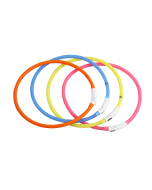
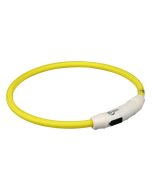
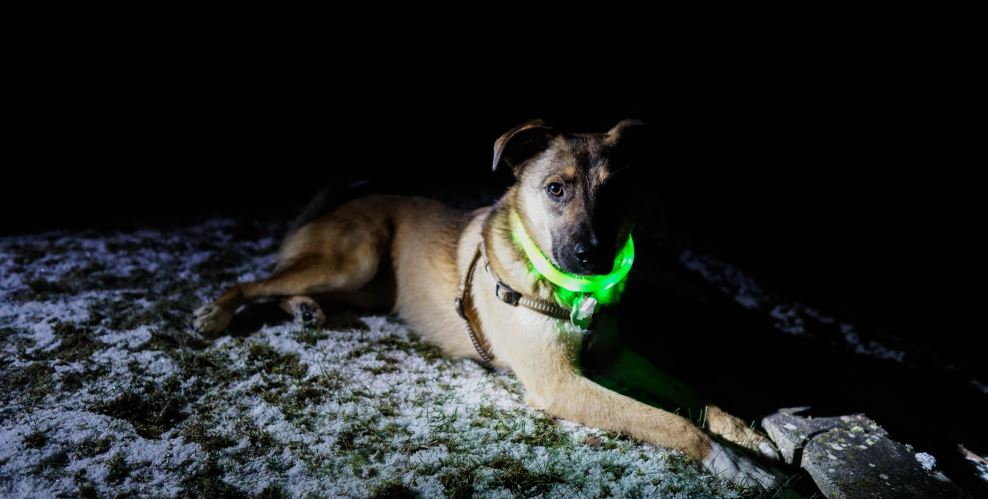
The two systems solve different problems. Active lights such as LED collars, light rings or pendants shine by themselves. They work everywhere, even where no headlight shines, such as on a field track, in the woods or in the park. Reflectors bounce the light of a headlight back and are strongest exactly where it gets dangerous: on the road. However, they need a light source to shine on them.
The rule of thumb: for walking along the road, your dog needs both. For off-lead time away from the road, an active light is enough so that you can see him.
How do I find the right light-up collar?
Size and fit
A light-up collar is worn in addition to the normal collar or harness, so it is not a replacement. Make sure it is securely attached to your dog's collar. Measure your dog's neck and choose a size so that two fingers fit under the band. For dogs with a thick, long coat, the band can be slightly looser, otherwise the light disappears in the fur. Many models, such as the universal light-up collar from swisspet, can be shortened to the right length. For short-haired, slim dogs, the band must fit snugly enough that it does not slip over the head during play.
USB or battery?
Models with a rechargeable USB battery have become the standard. Depending on the mode, they last from several hours to several evenings, can be charged with a phone charger and reduce battery waste. A light ring with USB charging is put on in a few seconds and fits in any jacket pocket. Battery models have one advantage: you can take spare batteries with you. For everyday use we recommend USB, and for holidays and long trips a battery version as a back-up.
Steady light or flashing?
A flashing light stands out more and is noticed from a greater distance. A steady light, on the other hand, helps you better read your dog's movement, i.e. whether he is standing, running or coming towards you. Most models offer both modes. Our tip: set it to flash by the road and to steady when he is off the lead.
Which colour is best?
Green and yellow are the most visible to the human eye at dusk. Blue looks weaker at a distance, and red is easily mistaken for rear lights. If you are out with several dogs, give each one its own colour so you can see at a glance who is where.
Reflectors: where should they go?
Reflective elements only work when a headlight hits them. That is why they belong where drivers look: on the side of the dog at headlight height, and all around so that the dog is visible from every direction.
- Reflective harness or collar: The basis. Many harnesses already have reflective stitching or stripes. You will find an overview in the reflective harnesses and reflective collars sections. A safety bandana also makes your dog more visible.
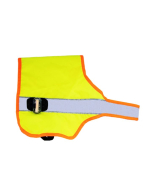
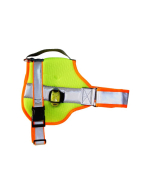
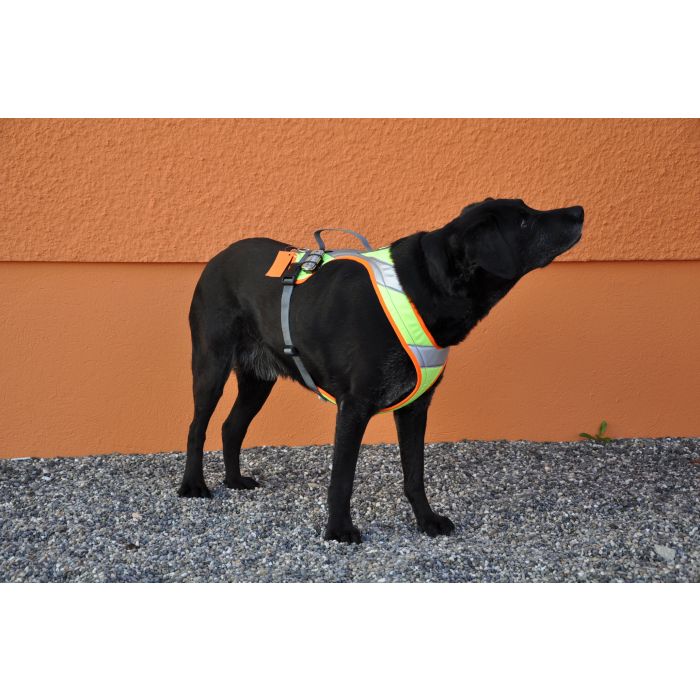
- Safety vest: A neon yellow vest is the largest reflective surface you can fit on a dog. Ideal for dark dogs and for anyone who walks along roads a lot. Make sure the vest does not chafe and does not restrict movement.
- Reflective lead: It shows the driver that person and dog belong together, and makes visible the connection that he would otherwise not see. You will find a selection in the reflective leads section.
- Light-up pendant: A small LED pendant on the harness is an affordable addition and fits any collar. However, it does not replace a collar that is visible from all sides.
- Light-up blanket: A light-up blanket also makes your dog visible from a distance.
For fun and games in the dark, there are also toys that glow in the dark.
Why shouldn't you forget about yourself?
The most common mistake: the dog glows like a Christmas tree, while the person next to him wears a dark jacket. Black jackets and dark trousers are almost invisible at dusk. Drivers then see a light at a height of 40 centimetres and don't expect a person beside it. You are often only noticed at the last second, if at all.
With little effort, you can make yourself more visible:
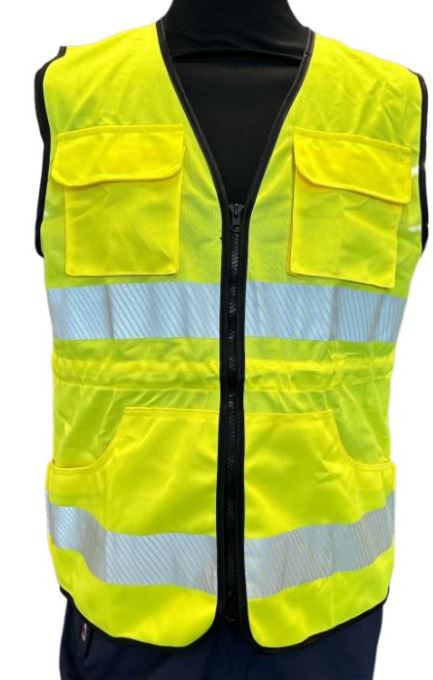
- Wear light-coloured clothing or accessories with reflectors, especially on your arms and legs. A hi-vis vest or a jacket with reflective stripes, for example a hi-vis gilet, doubles your safety.
- Use a head torch. It helps you see the path, the dog poo and your dog, and makes you visible to others. It is a must if you jog or cycle in the dark. LED lamps are more economical, brighter and more environmentally friendly.
- Alternatively, wear a small LED light on your rucksack or on your keyring.
- Make sure you are clearly visible even on short dog walks. Accidents often happen right outside your front door.
It's not about wrapping yourself in neon from head to toe, but about deliberately incorporating a few clearly visible elements. Visibility is not a trend, but a small everyday decision with a big impact: you protect yourself, your dog and everyone else on the road.
What are the five most common mistakes dog owners make?
- Only one pendant on the collar. From behind and from the side, the dog is invisible. All-round light is crucial.
- Light-up collar hidden in the fur. For long-haired dogs, the band must sit on top of the fur. Check this briefly after putting it on.
- Flat battery. Always charge the collar in the same place, for example next to the lead, and test it before you leave.
- Expecting reflectors to work off the lead. Without a headlight, a reflector does nothing. In the woods, you need an active light.
- Person without reflectors. See above. You are just as much part of the team as your dog.
What about cats?
Outdoor cats also spend more time out in the dark during the dark months. A reflective collar with a safety clasp that opens under tension makes them visible to drivers. The safety clasp is important so that the cat cannot strangle itself when climbing. Light-up collars with batteries are less suitable for cats because they are heavy and can get caught. For playtime indoors, on the other hand, there are light-up balls that bring movement to the game even in low light.
Frequently asked questions
When does my dog need a light-up collar?
As soon as you are out at dusk or in the dark. In Switzerland, in autumn and winter that is already the case on the evening walk, and in the darkest months often in the morning too.
Does the light bother the dog?
The light shines outwards and is hardly visible to the dog itself. What matters is that the band does not press and does not rattle. Most dogs no longer notice it after one or two walks.
How long does a USB light-up collar last?
Depending on the model and mode, between 4 and 12 hours per charge. Flashing uses less power than steady light. For an evening walk, one charge usually lasts a whole week.
Is a light-up collar waterproof?
Most models are splash-proof and survive rain and wet grass. For dogs that go into the water, you need a model that is explicitly stated to be waterproof.
Is a reflective harness enough?
By the road with car headlights, yes; off the lead without a light source, no. The safest combination is a reflective harness plus an active light-up collar.
In short
- Dark clothing: visible from 25 metres. With reflectors: up to 140 metres. The stopping distance at 50 km/h is 28 metres.
- Active light for off-lead time, reflectors for the road. Both together are safest.
- USB models for everyday use, green or yellow for the best visibility, all-round light instead of just one pendant.
- People need reflectors just as much as dogs do.
- You will find all light-up items, vests and reflective harnesses in our Protection and Safety section.
More for autumn: Shedding in dogs and cats and Hiking with your dog in autumn.