
Keeping rabbits properly is not entirely straightforward. They are prey animals and prone to stress, which makes it all the more important to keep them in a species-appropriate way. Here you will find out how much space rabbits need, which group suits them, how to set up the enclosure and what belongs on the menu.
How much space do rabbits need?
For rabbits, the legal requirements are a little more complicated. The floor area varies depending on the rabbit's weight and on whether there is a raised level. The legal minimum dimensions for 2 adult rabbits weighing up to 3.5 kg are 0.5 square metres, i.e. 100 x 50 cm with a height of at least 50 cm. Important: these are the internal dimensions, not the external ones.
However, as rabbits also have a need to dig and run, it is only fair to keep them outdoors so they can follow their natural activities. An outdoor enclosure of at least 15 square metres is recommended.
You can keep rabbits outdoors all year round. However, a hutch alone is not enough for them, no matter how big it is. They need access to the outdoors so they can hop around and dig to their heart's content. You can find more about keeping rabbits outdoors and in winter in our guide Keeping rabbits outdoors.
Which rabbits go well together?
Rabbits should never be kept on their own. Early-neutered males, also called "bucks", are a good choice. Early neutering means neutering young rabbits at around 3 months of age to prevent unwanted breeding and behavioural problems. Female rabbits, also called "does", can be quite aggressive towards each other, so this combination is rarely harmonious. Another option is a pair made up of a buck and a doe, where the buck should be neutered early to avoid unexpected litters. When keeping mixed groups, please be sure to have your rabbits neutered, as rabbits breed very quickly.

Is group housing possible?
Living in a group is the most natural way of life for rabbits. Personalities, sexes and existing dynamics within the group are decisive for compatibility. There are no fixed rules for the best group composition, but in general groups get along better when the sexes are balanced and the males are neutered. A surplus of females often corresponds to natural behaviour. It is important to have a plan B in case a new rabbit is not accepted.
Which enclosure types are suitable for outdoor housing?
Two types of enclosure are suitable for outdoor housing:
- Permanently installed enclosures: Fixed enclosures can be made escape-proof and predator-proof. A net keeps out martens, birds of prey and foxes, and also stops the rabbits from jumping over the top. In addition, runs with escape protection, paving slabs placed directly along the edge of the fence or wire mesh laid deep in the ground prevent the animals from digging their way out. Still, check any holes they have dug regularly.
The downside of fixed enclosures: the grass is quickly eaten away and the earthy ground turns into a muddy affair. So make sure you look after the lawn properly. - Movable models: With these enclosures you can change the ground regularly, so the rabbits always have fresh grass. However, as mobile outdoor enclosures cannot be built to be marten-proof and fox-proof, the rabbits need a break-in-proof hutch and a safe night enclosure. Simply shutting the rabbits in the hutch in the evening is not appropriate for the animals. Rabbits are crepuscular and would be locked in during their main active period.
How do you set up the outdoor enclosure properly?
Besides the size and security of the enclosure, the furnishings matter too. A secure rabbit enclosure needs wire mesh buried at least 1.5 metres deep in the ground to prevent digging attempts and keep intruders out. The top cover should always be closed so the rabbits cannot escape. The following are also part of a good set-up:

- The right hutch is a must: Every year-round outdoor set-up needs at least one insulated, dry hutch. It must be well ventilated in summer and protect against the cold in winter. You can create good cold protection with thick wooden walls or "boxes" with plenty of bedding. Keeping rabbits outdoors in winter is also only possible with at least four rabbits, as that is the only way to generate enough body heat to keep the hutch warm at night. An outdoor hutch is also a smart investment if you have a run, because it protects your rabbits from nocturnal predators.
- Fresh water every day: Change your rabbits' water daily. In group housing, several feeding and water points are important to minimise competition and stress. Water bowls are better than bottles here, as they allow rabbits a more natural drinking position.
- Shady spots are important: Use trees, shrubs or potted plants to provide enough shade in the enclosure. Hazel, fruit bushes and fruit trees are ideal. A sunshade or windbreak can often be bought together with the run. However, do not cover the enclosure with woollen blankets or thick tarpaulins, as heat will build up inside. Light-coloured cloths are better, because the air can circulate well underneath.
- Create places to retreat: Provide enough retreats with the hutch, small houses, as well as burrows and tunnels. Every rabbit should have access to a shelter with two exits, so it can avoid conflicts and feel safe. Crates and huts serve rabbits not only as shelter but also as a raised lookout.
- Variety in the enclosure: Whether ready-made products, your own constructions or things from nature, offer your rabbits plenty of entertainment. In Switzerland, the law also requires that rabbits always have access to gnawing material. It serves both to wear down their teeth and to keep them occupied. Twigs and branches from beech, hazel, birch, spruce and unsprayed fruit trees are suitable.
What do rabbits eat?
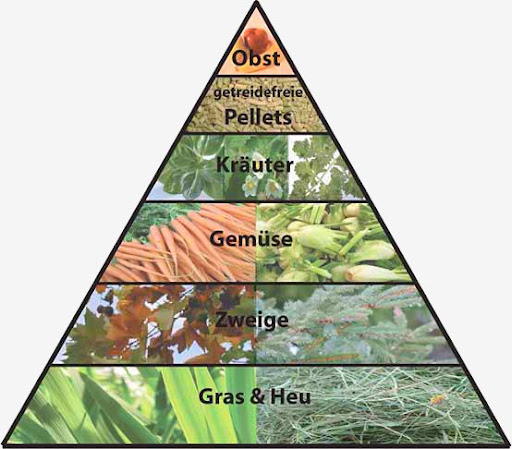
Rabbits are natural leaf eaters and need a varied diet to stay healthy. Hay is essential for digestion, as their digestive system depends on a continuous supply of crude fibre. Every day they should get fresh vegetables such as bitter salad leaves, carrots and various herbs to top up their nutrients. They also eat roots and bark. Fruit is fine in small amounts, but you should be careful, because rabbits are prone to diabetes. They may like commercial food, but it does not match their natural eating behaviour and can harm their health. It is generally not advisable to feed rabbits pellets, except in small amounts and only grain-free varieties.
How do you keep rabbits properly indoors?
Swiss Animal Protection is critical of keeping rabbits indoors. As a rule, only outdoor housing offers enough space and allows rabbits to satisfy their need to dig. If you still want to keep your rabbits at home, they need their own quiet "rabbit room". There you set up an enclosure that is always open. Equip this enclosure with enough bedding for digging, a hay rack, as well as food and bowls or drinkers. As with outdoor housing, also provide hiding places and raised levels with huts, tunnels and crates. Here too, your rabbits regularly need fresh branches and twigs.
You also need to take care of safety: cables and sockets within the animals' reach must be covered. Rabbits also like to nibble on furniture or wallpaper, so make sure they cannot get to them. We advise against uncontrolled free roaming in the home.
What does an outdoor enclosure look like in practice?
An example from the Petcenter team: for four rabbits, an enclosure of 12 square metres was built. As rabbits love to dig, the ground was first excavated and wire mesh laid so the enclosure is escape-proof. The whole area was then fenced in and equipped with small huts, a large hutch, stones for wearing down their claws, cork tubes, drinkers and hay racks. Construction took three months. The rabbits explored their new home straight away, clearly felt at ease and over time dug huge underground tunnels.
As the animals are outside in all weathers, they do not like being handled. Rabbits are not cuddly pets but prey animals. That makes it all the nicer to watch them play, romp or sunbathe.

What does Swiss Animal Protection say about keeping rabbits?
The Animal Welfare Ordinance (Tierschutzverordnung) sets out minimum requirements for keeping animals. These are the legal minimum and not animal-friendly housing: the more space, the better. In the leaflets of Swiss Animal Protection STS, which are available online, you will find information on species-appropriate housing. The hutches and runs in the shop are labelled with declarations of the legally permitted animal species.
In the leaflet from Swiss Animal Protection you will find information on animal-friendly rabbit keeping and on the legal requirements:


Image sources: Shutterstock, kaninchentreff.de, auffangstation-zarfl.com, Jenny Zeier