
The myth that BARF needs countless supplements to keep a healthy dog healthy is stubbornly persistent. It is simply not true. Here you will find out which supplements are really necessary, which herbs, oils and extras can be useful, and which nutrients your dog needs.
Which supplements does your dog really need on BARF?
If the daily BARF ration contains the right animal and plant components in the correct proportions (find out more in our guide BARF for Dogs: What Goes in the Bowl?), a healthy dog needs only three supplements in their diet, from puppy age through to senior.
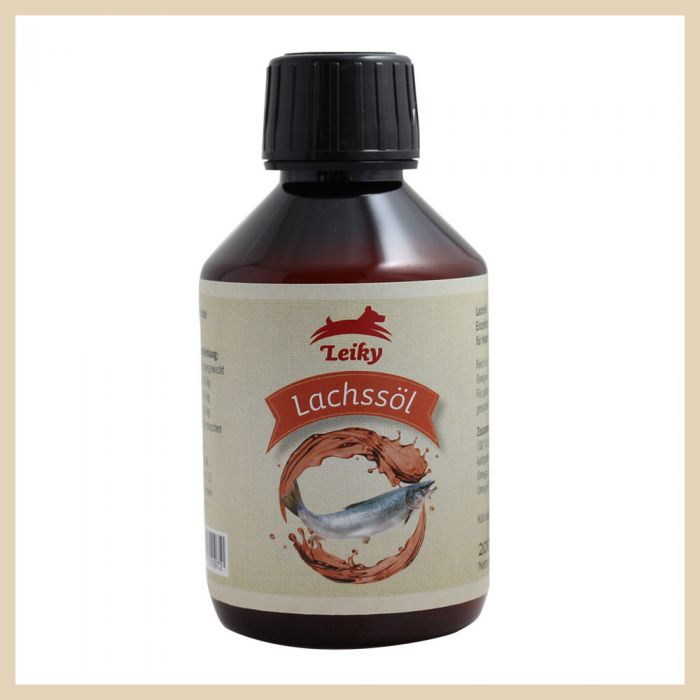
1. Salmon oil with vitamin E
Omega-3 and omega-6 fatty acids are essential fatty acids, as dogs cannot produce enough of them themselves. Meat from factory farming supplies an excess of omega-6 fatty acids. That is why an oil with a high omega-3 content must be added to the diet. Fish oils have the highest proportion of omega-3 fatty acids, and salmon oil or wild salmon oil is ideal. Before feeding, the oil must always be fortified with vitamin E to stabilise it and to help your dog absorb the omega-3.
Dosage: As a guideline, use about 1 teaspoon of oil per 10 kg of body weight per day; the manufacturer's packaging instructions take precedence.
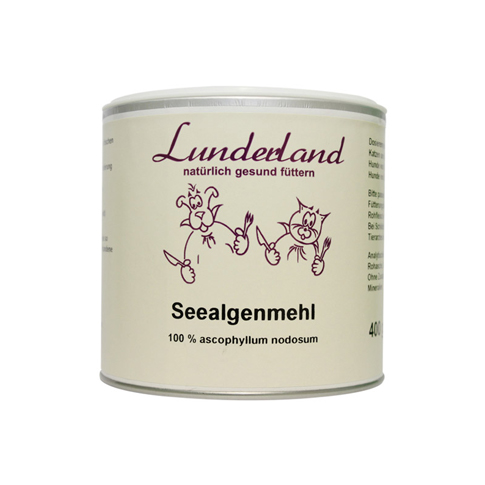
2. Seaweed meal
With BARF, the iodine-rich thyroid gland of the prey animal is not fed, as the hormones it contains could affect your dog's thyroid. Marine algae serve as a substitute, e.g. bladderwrack or Ascophyllum nodosum. They are particularly rich in iodine and minerals.
Dosage: The amount of seaweed meal per week depends on the daily food amount:
| Daily food amount | Seaweed meal per week |
|---|---|
| under 80 g | 0.5 to 1.5 g |
| under 250 g | 2 to 3 g |
| under 450 g | 3 to 4 g |
| under 550 g | 4 to 5 g |
| under 700 g | 5 to 6 g |
| above that | increase accordingly |
3. Cod liver oil
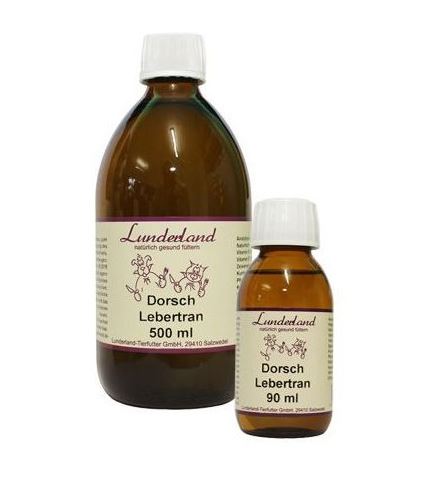
Cod liver oil is obtained from the liver of fish (e.g. cod) and mainly serves to supply vitamin D. If you feed your dog a portion of fish instead of muscle meat once a week, you can do without the cod liver oil. This does not apply to the salmon oil, which must always be fed.
Dosage: Dose according to the manufacturer's packaging instructions.
Which other supplements are handy?
Besides the three essential BARF supplements, there are other additions that can be added to the bowl permanently, as a course or seasonally:
- Rosehip: It is the plant with the highest vitamin C content. Vitamin C helps with arthritic complaints and stress and is necessary for building cartilage and bone. Rosehip is especially recommended for dogs prone to joint problems and can be fed as a course or permanently.
- Green-lipped mussel: This powder supports joint function and your dog's agility and can be added as a course or permanently.
- Slippery elm bark: It helps with digestive complaints and supports the gut flora. You can feed it as a course for acute complaints or permanently.
- Eggshell powder: A source of calcium, important for bones and teeth.
- Coconut oil: is traditionally used against parasites and can be used both externally and internally.

Which herbs are suitable for BARF?
Herbs are not just tasty additions, they also offer health benefits. They can strengthen the immune system, aid digestion and have a supportive effect on certain complaints. Popular herbs and their effects:
- Parsley: rich in vitamin C, supports kidney function
- Nettle: promotes blood purification and has an anti-inflammatory effect
- Dandelion: supports the liver and gall bladder, has a diuretic effect
- Chamomile: soothes the gastrointestinal tract and has an anti-inflammatory effect
How to use herbs:
- Dosage: Start with small amounts and watch how your pet reacts.
- Form: Mix them into the food fresh, dried or as an herbal tea infusion.
- Quality: Make sure the herbs are unsprayed and of high quality.
Note: Not all herbs are suitable for animals. Find out beforehand which herbs are safe.
Which oils provide important fatty acids?
Oils provide omega-3 and omega-6 fatty acids, which your pet cannot produce itself. They support skin, coat, joints and the immune system. In addition to salmon oil, which remains a fixed part of the ration, other oils are an option:
- Salmon oil: rich in omega-3 fatty acids, promotes healthy skin and coat
- Linseed oil: a plant-based source of omega-3, supports the metabolism
- Hemp oil: contains omega-3, omega-6 and omega-9, has an anti-inflammatory effect
- Evening primrose oil: high in gamma-linolenic acid, helpful for skin problems
For the other oils, the same guideline applies. Store oils in a cool, dark place to avoid oxidation. Alternate between different oils so that the fatty acid profile stays balanced.

Which nutrients does your dog need?
To keep your dog healthy and allow all bodily functions to work properly, their diet must provide a balanced mix of proteins, carbohydrates, fats, minerals and vitamins. These must be present in sufficient quantities and in a balanced ratio.
Proteins
Proteins are important for building bones, muscles, skin, fat, blood and tissue. They are made up of amino acids, which can come from plant or animal sources, for example meat, vegetables, fruit, fish, eggs or dairy products. A dog can only obtain essential amino acids through food, and they are vital. The body can produce the non-essential amino acids itself.
Fats
Fat is the most important source of energy. It is available to the dog as storage fat (saturated fatty acids) and as a nutrient for the metabolism (unsaturated fatty acids). Fats also carry the fat-soluble vitamins A, D, E and K. Most fats are highly digestible and well tolerated, and their energy content is at least twice as high as that of proteins.
Carbohydrates
Carbohydrates mainly provide the body with energy needed in the short term and are found in almost all foods. The most important building block is glucose. It supplies cells and tissue with energy and feeds your dog's blood cells and brain. Foods with a high glucose content include sweet potatoes, courgettes and parsnips.

Minerals
Dogs have to take in minerals from outside, as the body cannot produce them itself. They serve as building materials for bones and teeth and are involved in the metabolism. Bulk elements such as calcium, phosphorus or magnesium occur in relatively high concentrations in the body, while trace elements such as iron, zinc or copper are present only in small but crucial amounts. The most important minerals and their functions:
| Mineral | Function |
|---|---|
| Calcium and phosphorus | In the body, they are mainly bound in the bones and teeth. Some can be mobilised from the organs when needed, which is important because the calcium level in the blood should stay as constant as possible. Calcium plays an important role in bone formation, nerve signal transmission and blood clotting. Phosphorus is mainly needed for fat transport. |
| Magnesium | Converting protein, fat and carbohydrates into energy, supporting heart function, preventing blood clots, relieving stress, bone formation |
| Sodium, chlorine and potassium | Fluid regulation, acid-base balance, signal transmission in nerve and muscle fibres |
| Iron | Oxygen transport in the blood, support of the immune system |
| Copper | Production of connective tissue and blood, formation of the skeleton, pigmentation of skin and coat |
| Zinc | Component of various enzymes, involved in the metabolism of carbohydrates, fats and proteins |
| Iodine | Production of thyroid hormone, control of the metabolism, regulation of energy balance |
Vitamins
Vitamins are vital and must be present in small but sufficient amounts. Dogs have to take them in from outside, as they cannot produce them at all, or not in sufficient quantities.
The water-soluble vitamins include the B complex and vitamin C for a strong immune system. In case of an overdose, they are excreted in the urine, while an underdose leads to deficiency symptoms straight away. The fat-soluble vitamins A, D, E and K are stored in the liver in case of an overdose and can cause problems. With an underdose, deficiency symptoms only show up over time, as the body can draw on the stored vitamins.
What should you look out for with supplements?
- Individual tolerance: Every animal reacts differently. Introduce new supplements slowly and keep an eye on your pet.
- Quality over quantity: Choose high-quality products without additives.
- Advice: If you are unsure or your pet has existing health problems, consult an animal naturopath or your vet.
With the right knowledge and a careful selection, you can offer your four-legged friend a varied and nutrient-rich diet.
Want to try BARF yourself?
Would you like to feed your dog BARF but don't yet feel confident doing it alone? Our certified nutrition consultants specialising in BARF according to Swanie Simon will be happy to create a personal and easy-to-understand BARF plan for you. The BARF book by Nadine Wolf also gives you comprehensive and clear insights.
Learn more about BARF: